In the Beginning
As described on the Surname Origins page, we believe that the Baldacchino surname, along with most of the oldest Maltese surnames, originated in Sicily. M Cassar explains that from 1130-1530, Malta was a geographical entity of the Kingdom of Sicily with the same political status as other Sicilian communes and writes:
‘… [C]ontrary to one’s expectation of finding in the south-eastern corner of Sicily the closest onomastic agreement with Malta, the Gela-Caltanissetta-Agrigento axis appears to be the source of most of the oldest Maltese surnames, with the latter district as the obvious epicentre. One important characteristic which 12th century Girgenti [historic name of Agrigento] had in common with Malta was that it was then … a bastion of Arabic speech and Islamic faith in a Sicily that was in the process of being Latinized and Christianized’ (Mario Cassar, ‘Malta and Sicily: An overview of their Cognominal Kinship’, Symposia Melitensia Vol 17 (2021), pp. 65-80).
G Hull hypothesized that these commonalities led to a group of Christian colonists from the city of Agrigento, capital of the Agrigento Province, being sent to populate Malta once the Maltese Muslims had been expelled in about 1250 (Geoffrey Hull, ‘The Oldest Maltese Surnames: A Window on Sicily’s Medieval History’in C Karagoz, G Summerfield (eds), Sicily and the Mediterranean (2015), pp. 77-990).
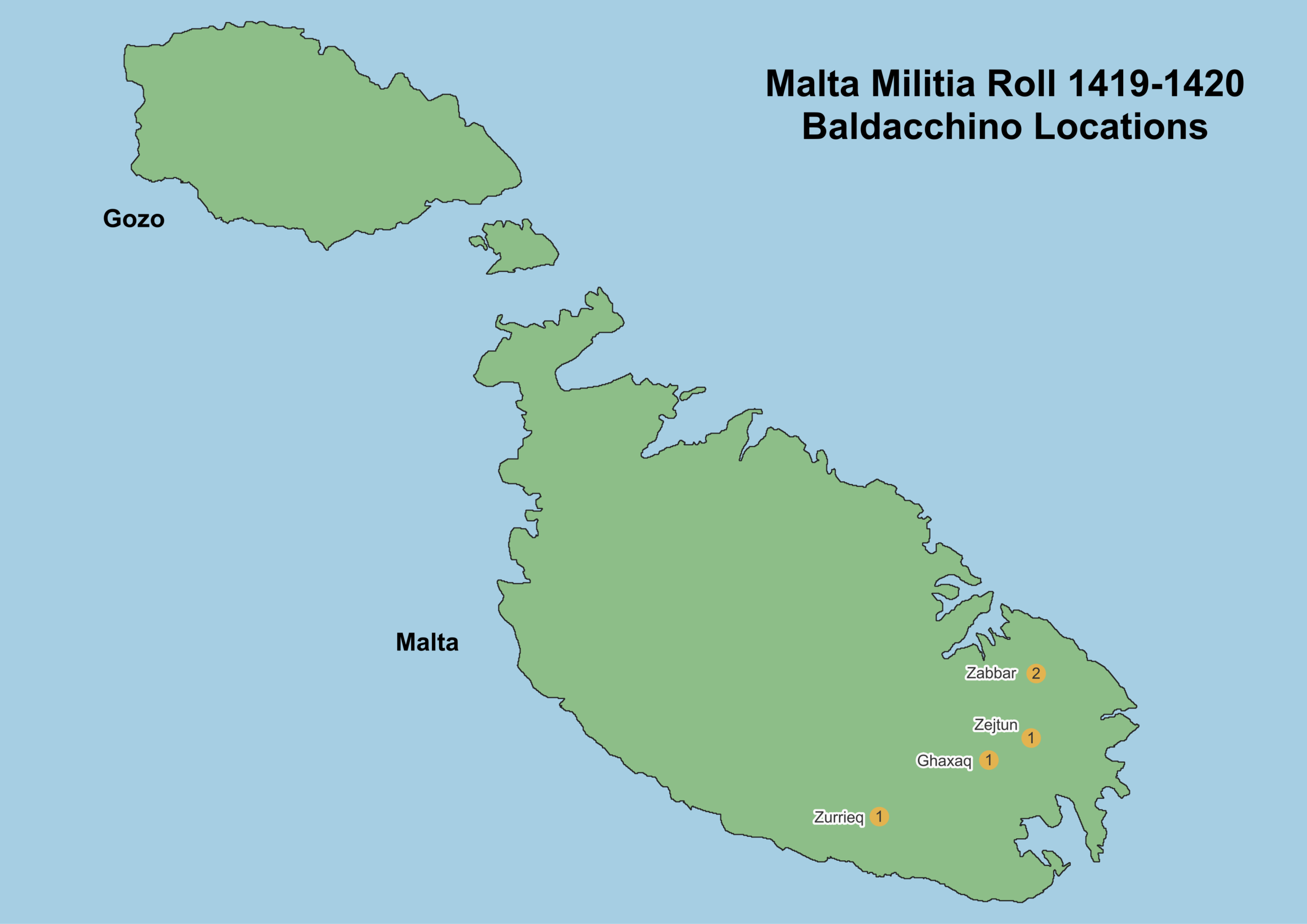
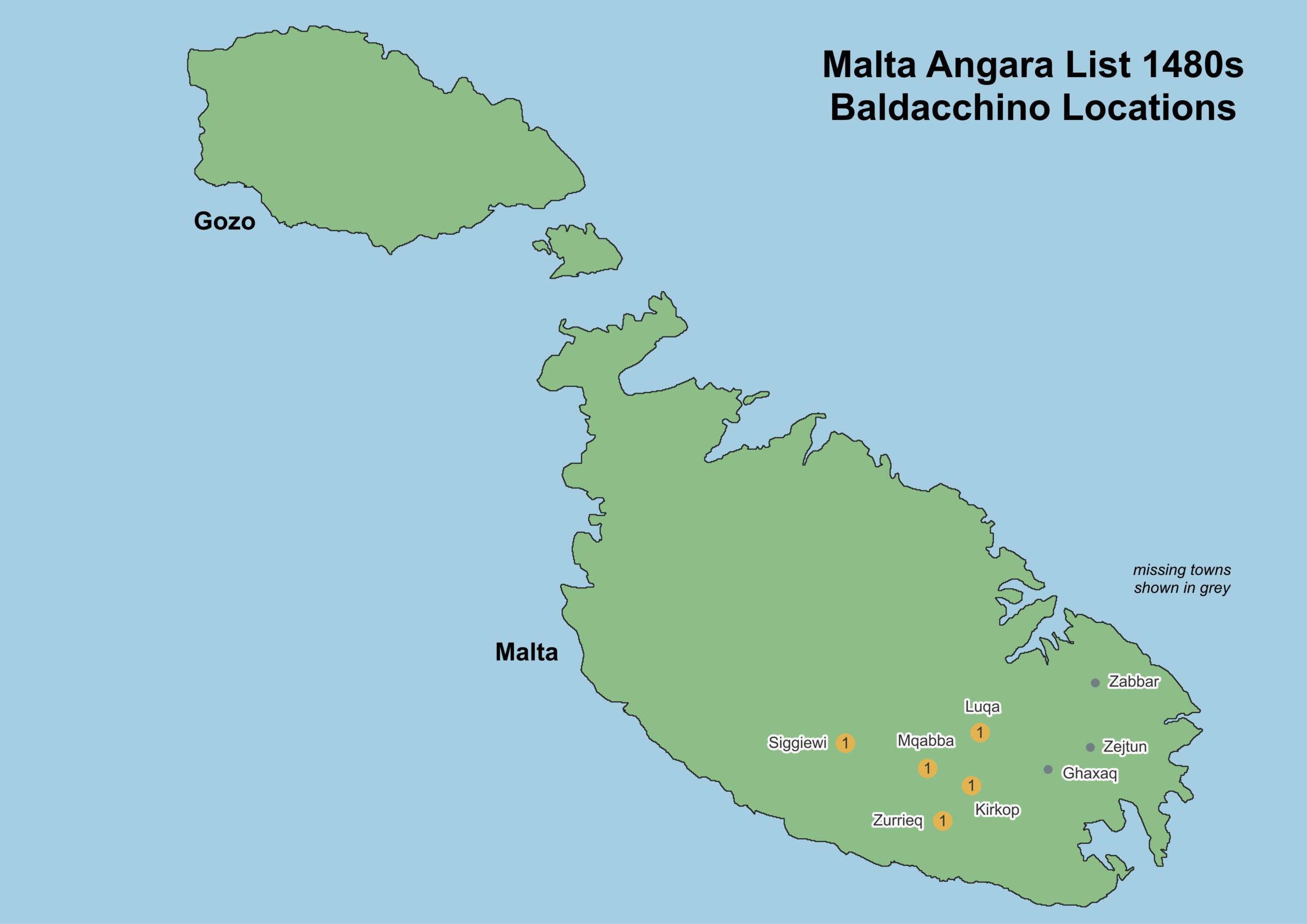
Two 15th century documents were introduced by G Wettinger in the late 1960s that provide a remarkable starting point for research on surnames in Malta, a 1419-20 militia list and a 1480s angara list containing the names of those who were required to participate in public works on a scheduled basis (G Wettinger, ‘The distribution of surnames in Malta in 1419 and the 1480’s’, Journal of Maltese Studies, vol 5 (1968), pp. 25-48 and G Wettinger, ‘The militia list of 1419-20 : a new starting point for the study of Malta’s population’, Melita Historica, Vol 5, No 2 (1969), pp. 80-105). The lists have their limitations including the omission of Vittoriosa (Birgu) and Gozo from both lists and the loss of Zabbar, Zejtun and Ghaxaq from the 1480s list. The loss of these last three villages is almost certainly significant for the Baldacchino surname because they are three of the four villages that Baldacchinos were located in at the time of the 1419-20 list. The lists include able-bodied men age 16 to 60 available for military or public works duty, with a ratio suggested by academics of 5 or 6 family members for each household in the list (4 in 1419-20). They identify five men with the surname ‘Baldakin’ living in four villages in 1419-20 and another five in the 1480s living in five villages slightly west overall of the earlier villages no doubt due to the eastern-most villages being lost from the list. Like other Sicilian settlers at this time, the Baldacchinos were concentrated in the southeast of the island of Malta. Also, despite the omissions, the lists leave little doubt that the Baldacchinos were in Malta by the mid-1300s and further academic analysis suggests that the surnames that came from Agrigento Province, Sicily including Baldacchino may have been in Malta even earlier. We haven’t yet seen the forenames of those in the 1480s list yet but our own ancestor, Mario of Gudja born in the mid-1400s, seems likely to have been amongst these families. Note that Johanni et Buzubudi is now Gwann and Bisbut, parts of Zejtun. Axac is modern-day Ghaxaq, Percopu is Kirkop and Micabibe is Mqabba.
Migration
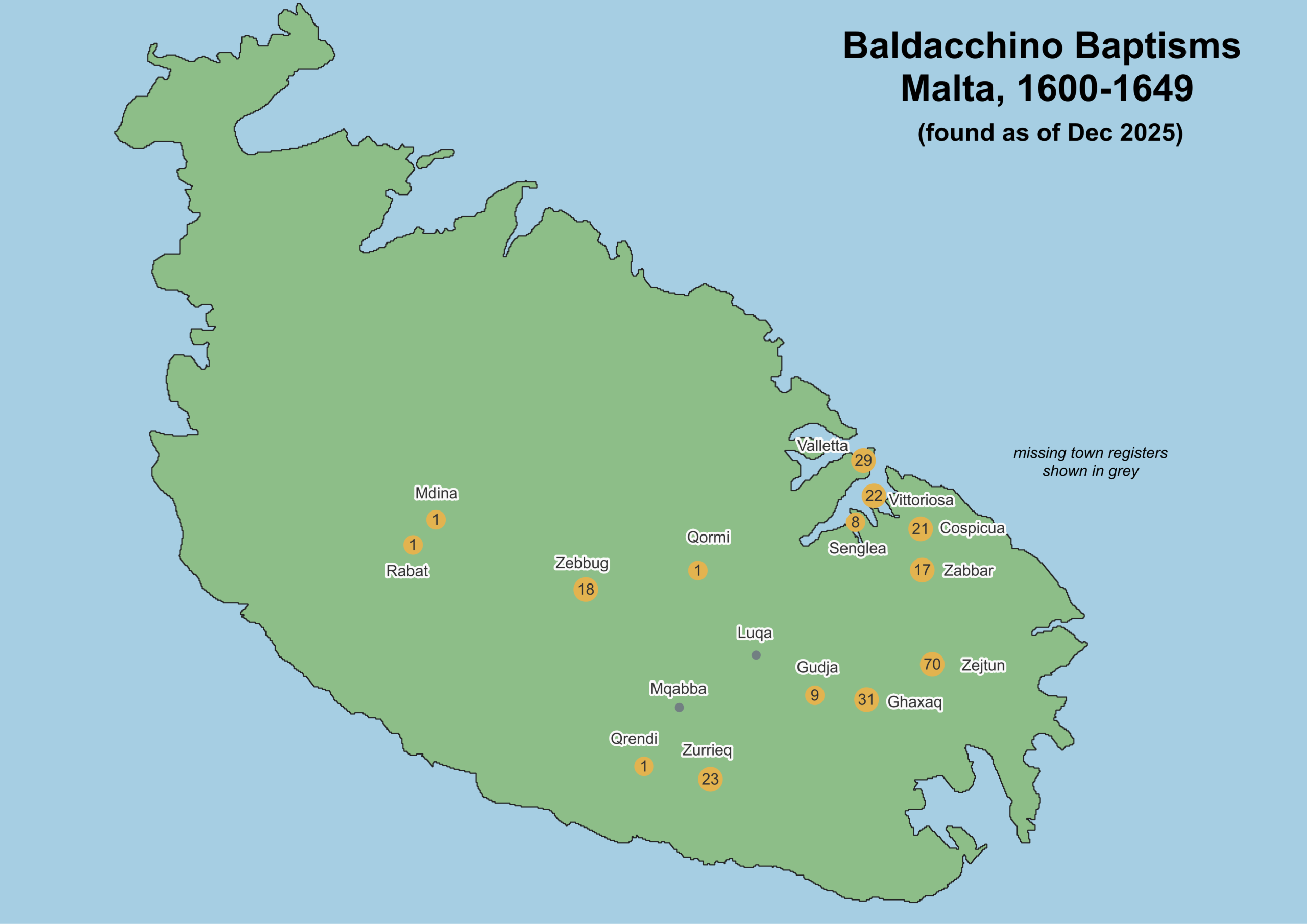
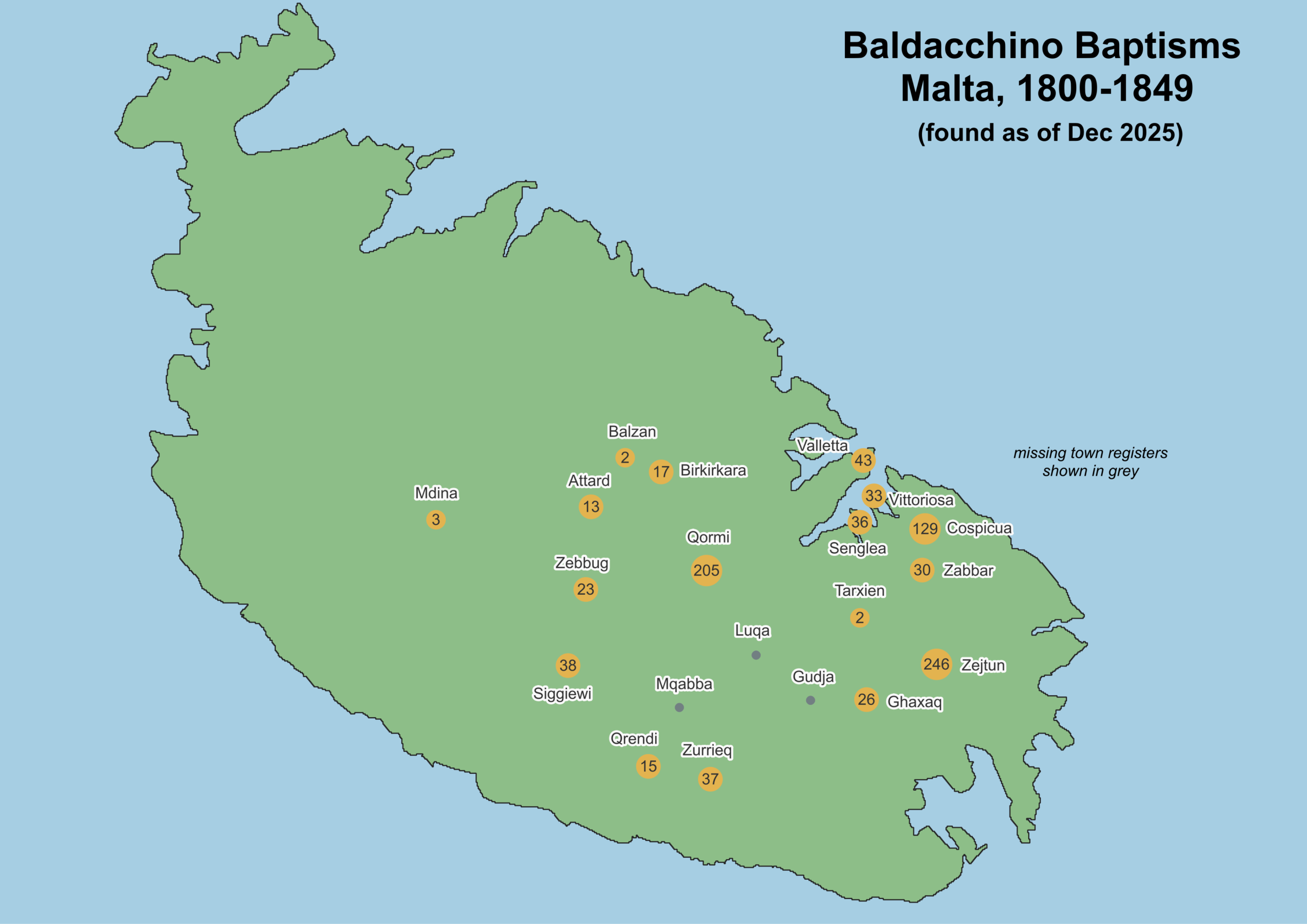
The only sources used at present to show internal movement in the 16th-19th centuries are church registers but they provide more of an indicative picture rather than a complete one since there are major gaps in the registers accessible online. Note any internal movement is very short-distance given that the island of Malta is only about 17 miles long and 9 miles wide. The charts below show the baptisms we have found to date with missing registers likely to contain Baldacchino baptisms shown in grey. In addition, for the period 1550-1599, a number of the registers do not begin until the 1570s-1590s. Still it is apparent that the families remained largely in the southeast at the start of the registers but had begun spreading north and west. The Knights of Malta had been given the island in 1530 and Baldacchinos began moving toward the Knights’ first administrative centre in Cospicua (Birgu). Following victory in the 1565 Great Siege of Malta by the Ottomans, the Knights quickly began building Valletta, overlooking the Grand Harbour, which would become their new administrative centre and remains the capital of the country today.
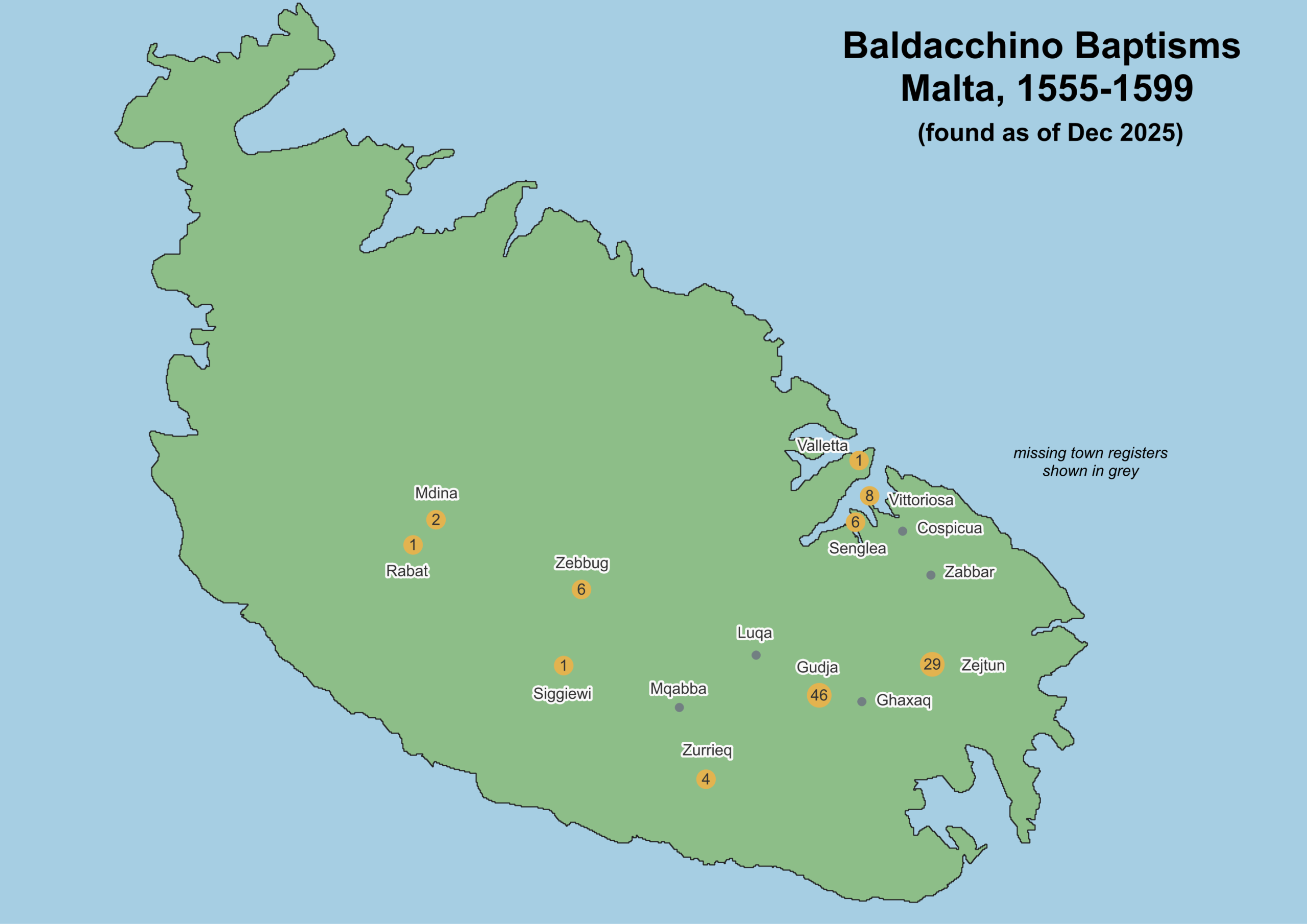
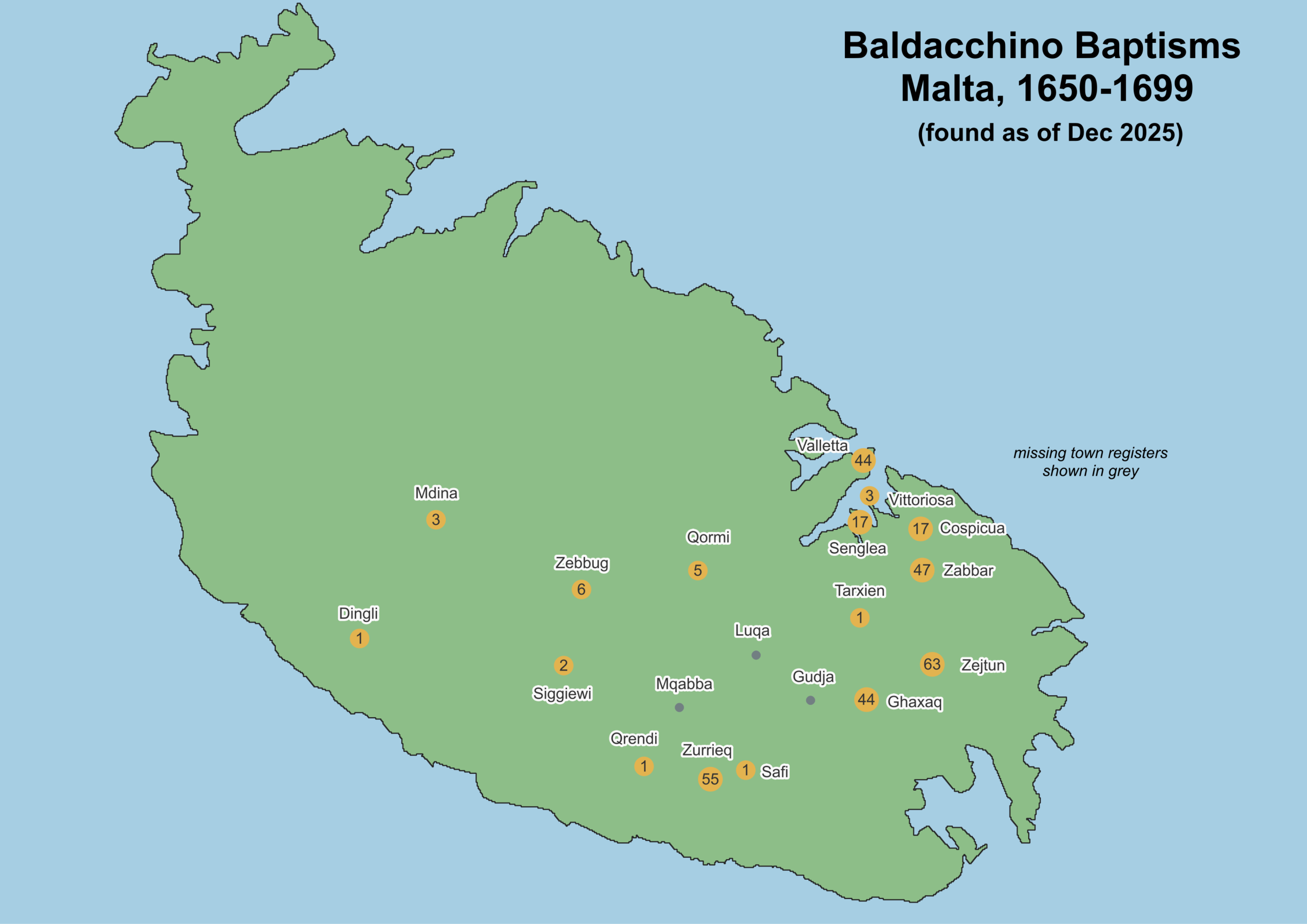
Similar trends continued into the 1700s with the areas in and around Valletta continuing to expand but with large numbers of Baldacchinos still remaining in the southeast. These trends were similar to the broader Maltese population, much of it driven by the geography of the island including the Grand Harbour and the lower elevation, more fertile lands of the southeast where families had originally settled.
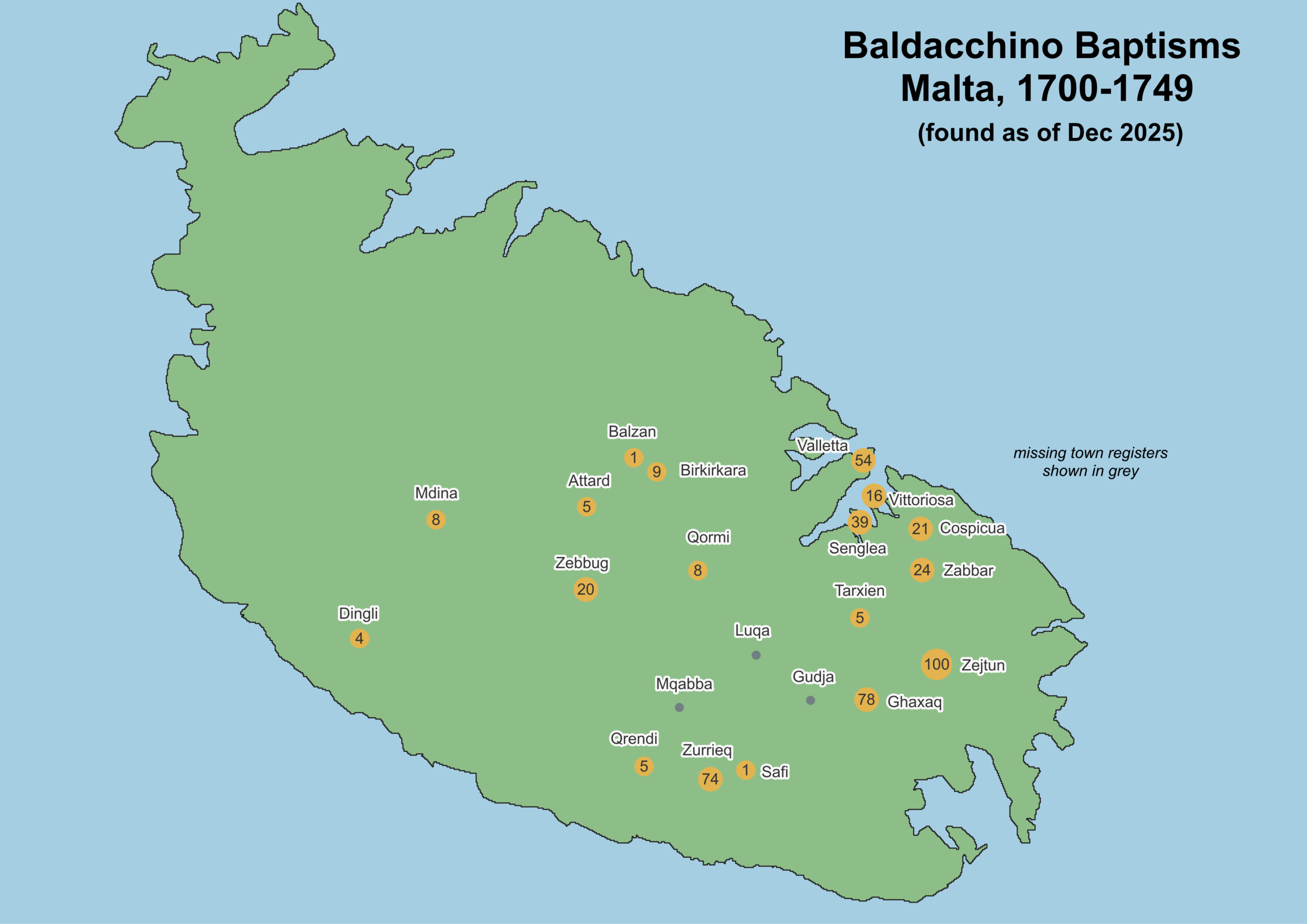
At the end of the 18th century, Napoleon’s armies briefly occupied Malta, the Knights departed, the British dispelled the remaining French contingent and then assumed administrative control until Malta’s independence in 1964. The early 19th century witnessed the beginning decline of Baldacchinos in the Valletta area as mainly British personnel took on administrative responsibilities, with the Baldacchinos choosing other areas slightly beyond the spreading urban sprawl of the capital. Zejtun would remain a strong preference for Baldacchino families but Qormi was already well on its way to becoming the favoured location for Baldacchino families that it is today.
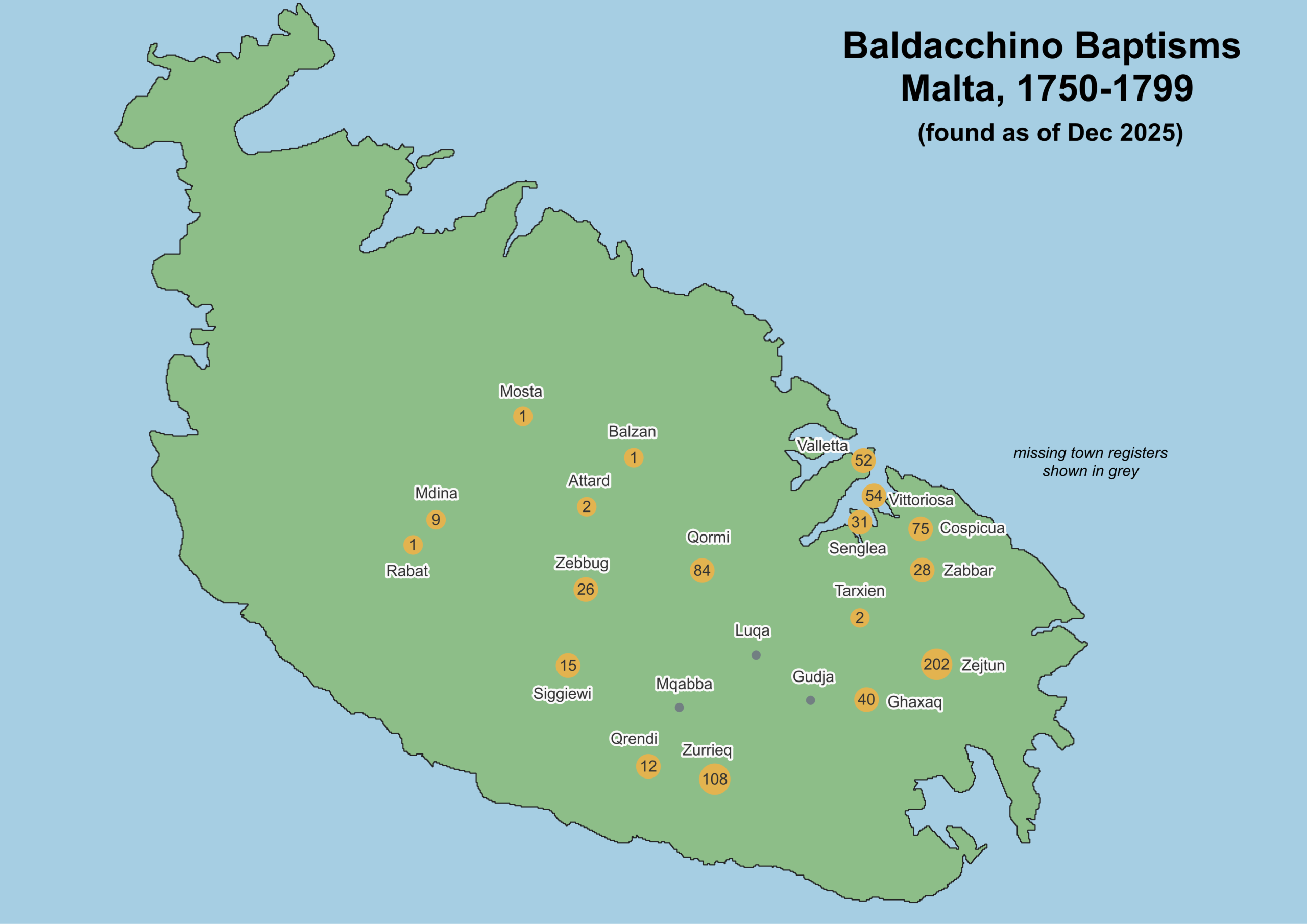
See the Surname Distribution page for an overview of overseas migration from Malta.
The Surname Today
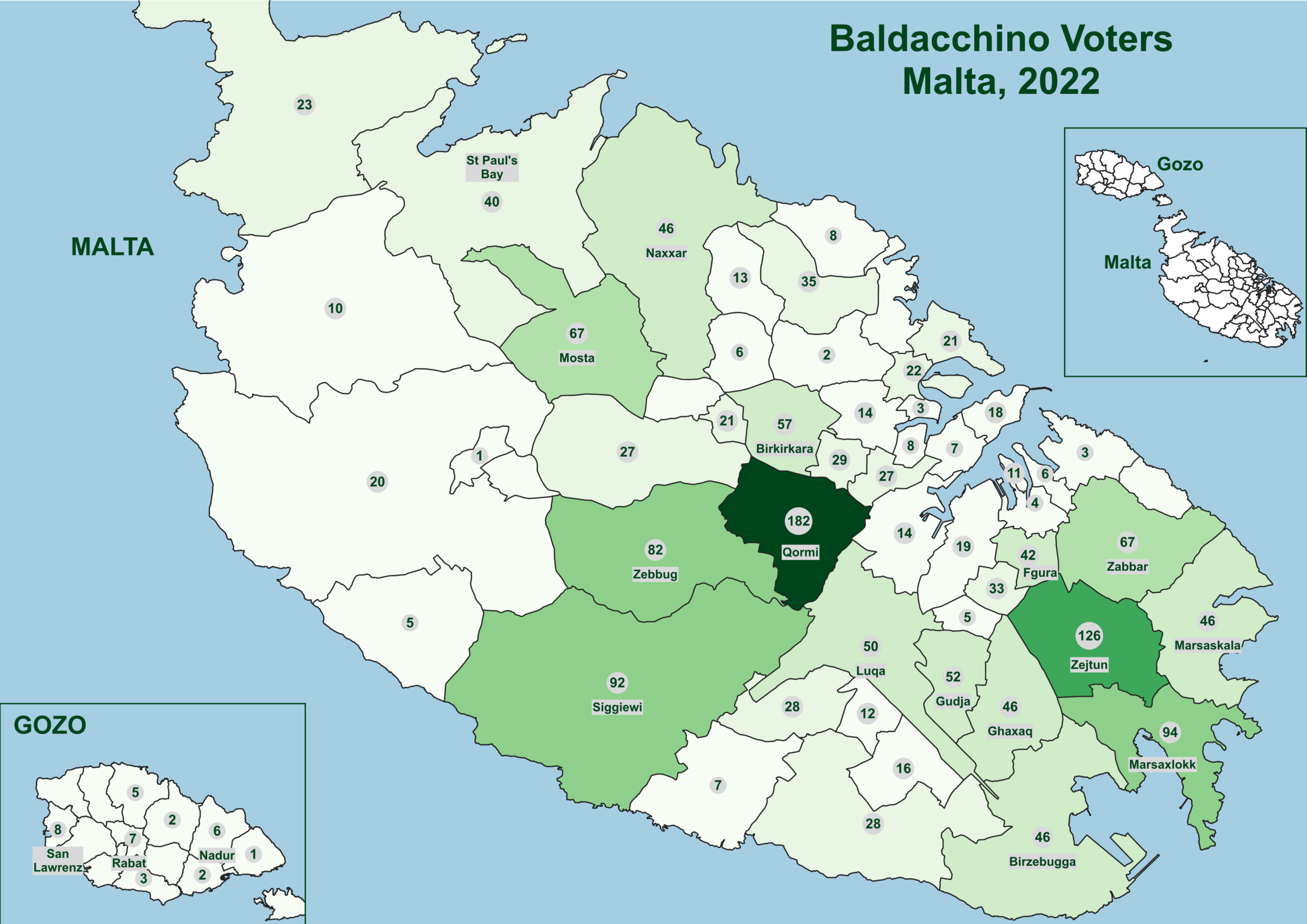
Forebears.io estimates that, in 2025, Malta had 2111 people with the surname Baldacchino, with another 18 reported as Baldachino. Those with the spelling Baldachino are undoubtedly misspellings. We believe that this is a good estimate since we know from the 2022 Malta Electoral Rolls, available from the National Library and available online to those with Maltese identification cards, that there were 1675 registered Baldacchino voters with at least another 90 having Baldacchino as part of a double surname such Baldacchino Kerr or Gatt Baldacchino. Voting participation is very high in Malta and open to those 16 and over, so these numbers should be a fair reflection of the adult population in 2022.
Maltese surnames are very dense with approximately 75% of the population holding the top 100 surnames, and Baldacchino ranked 50th amongst Maltese surnames in 2025 according to Government statistics available at surnam.es/malta. Qormi, just outside the urban sprawl of Valletta, is by far the preferred location for Baldacchino families and most families remain in the southern towns of the island, close to where the original Maltese Baldacchinos settled. A small number of Baldacchinos now live on the island of Gozo but historically the name is generally only found on the larger island of Malta.