The Baldacchino surname and its variants spread worldwide through overseas emigration. The earliest migrations are difficult to see on a worldwide map since Sicily and Malta are only 60 miles apart but the Baldacchino surname began spreading when Sicilian migrants from the Agrigento Province of Sicily, Italy were sent to re-settle Malta in the 13th and 14th centuries following the end of several centuries of Arab rule. Since Sicily and Malta were both under the same feudal lords by that time, movement between the islands was relatively easy. A significant counterflow took place from Malta back to Sicily in the years following Malta’s victory over the Ottomans in 1565. The same invading force had devastated the city of Licata in the southeast corner of Agrigento Province in 1553 and a significant number of Maltese migrated to Licata to re-populate the city, establishing a new quarter in the city known as Borgo di San Paolo or alternatively, Borgo dei Maltesi. It was amongst these settlers that the variant surname Ballacchino arose and fully replaced the Baldacchino surname in Licata by the end of the 17th century. The Ballacchino form of the name never arose in Malta itself and is a strong indication of Sicilian emigrants wherever it is found worldwide.
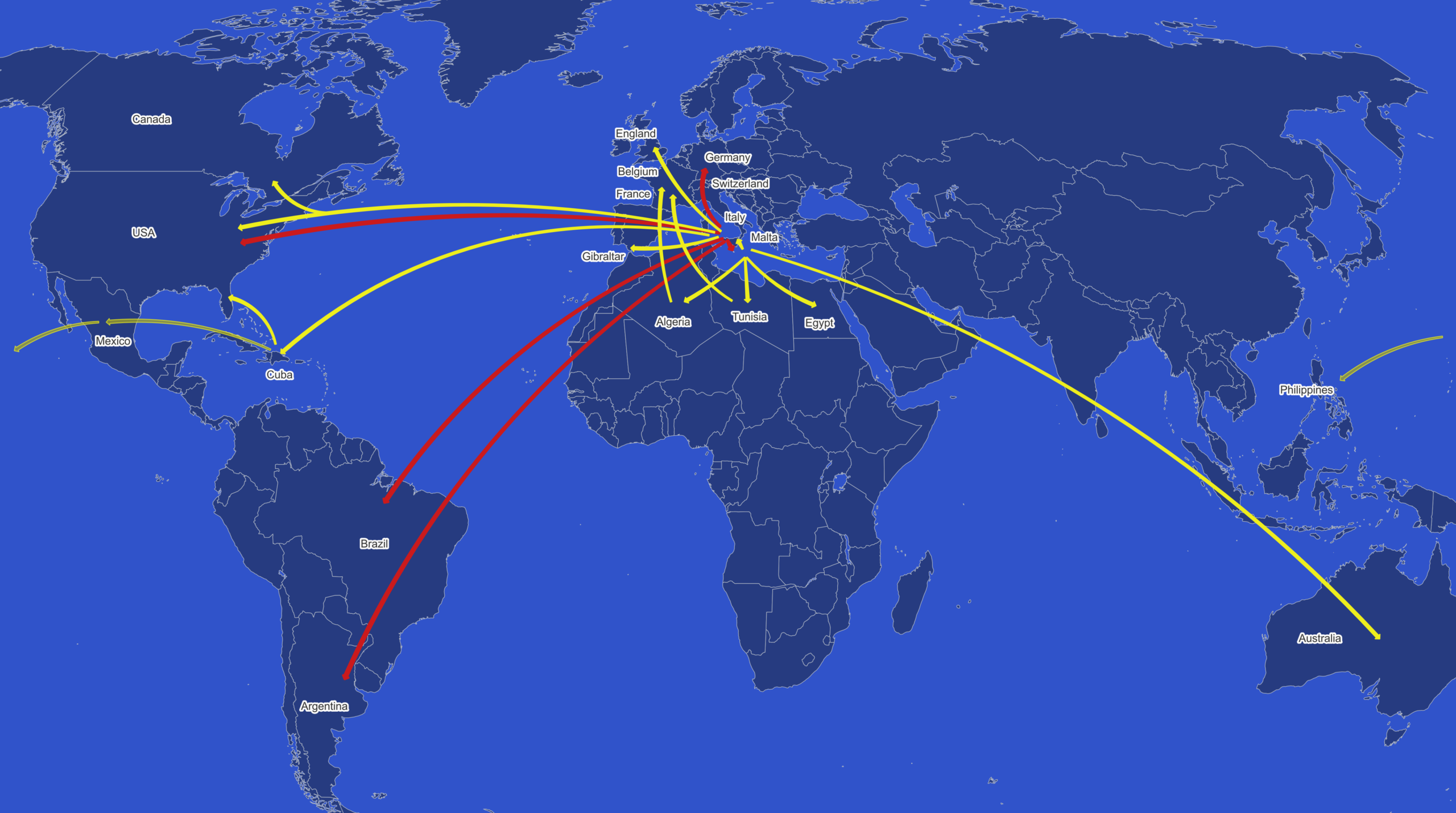
The map below identifies the major routes of Baldacchinos and variant names emigrating overseas. Red routes indicate a preponderance of Sicilian emigrants while yellow routes indicate a preponderance of Maltese emigrants. There may well be both Sicilian and Maltese emigrants in most of the countries highlighted but we believe that one or the other nationality is more prevalent based on the evidence we currently have. After several centuries of the names spreading within Italy and Malta, more evidence of overseas movement becomes available. More detail at the points of origin and destination of each route may be found on the Country tabs.
Malta to Central America:
As explained on the Cuba page, we believe that Francisco Javier Baldaquin, born in Malta as Francesco Saverio Baldacchino, emigrated to Cuba in the latter 1700s. While we have not yet found any online Cuban source for genealogical records, there are a few Mexican records for Baldoquins in the late 18th to mid-19th centuries. We believe that Francisco spread the Baldoquin name to Mexico, a country that along with Cuba had long been a centre of trade between Spain and the Philippines:
‘For 250 years, from 1565 to 1815, Spanish galleons shuttled between Acapulco and Manila, exchanging treasures of the West for those of the East … described as “one of the most persistent, perilous and profitable commercial enterprises in European colonial history”… Acapulco began as the Spanish port from which good received from the Orient were transported overland by mule to present day Mexico City and then to Veracruz on the Gulf of Mexico, where the goods were reloaded on ships bound for Spain that rendezvoused with other Spanish ships in Havana [Cuba] for the trip to Spain.’ (Spanish Galleon Trade between the Philippines and Mexico [accessed 13 Dec 2025]).
This trade route continued under a variety of trading firms in Manila following Mexico’s independence from Spain in 1821, with great prosperity brought by the huge increase in global trade due to the advent of steam travel and the opening of the Suez Canal. This trade route may have been the means by which the Baldoquin surname spread to the Philippines but further Big Y-700 DNA testing and other supporting evidence are needed.
Malta to North Africa: Although sources are limited, records of Maltese emigrants to North Africa have been found from 1839 to the 1960s, mainly to Tunisia and Algeria and a smaller number to Egypt with trace numbers also to Libya and Morocco. As the map below shows, North Africa remained the primary destination for Maltese emigrants into the early 1900s. The Maltese economy fluctuated under British administration in the 19th and 20th centuries, with the economic health of Malta responding to major changes in British investment, plague outbreaks and crop failures, impacting employment opportunities. The North African countries could be reached at minimal cost by Maltese boats and the settlers were drawn by a wide variety of opportunities such as labourers, merchants, French and English military duties and employment in shipyards and shipping. Those who emigrated to French territories in North Africa remained British citizens for two generations and were then offered French citizenship.
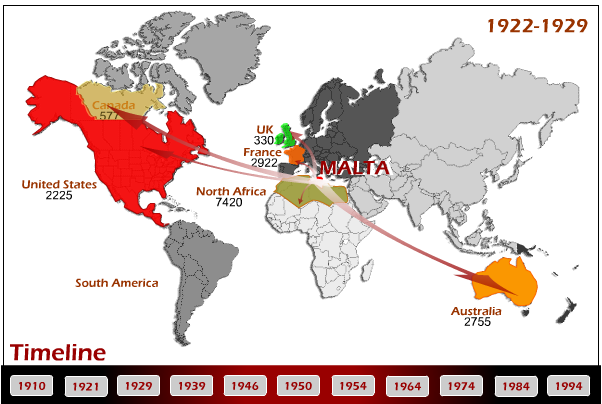
As North African countries gained their independence in the mid-20th century, those of Maltese origin were generally not permitted to return to Malta. Many of the emigrants in Tunisia and Algeria subsequently moved to France, with possible leakage to Belgium. Those expelled from Egypt during the Suez Canal crisis in the 1950s mostly settled in Australia or England.
Malta to Gibraltar: Between 1860 and 1890, four Maltese families emigrated to Gibraltar for varied employment opportunities, Gibraltar and Malta were both under British administration at the time. These emigrants are the ancestors of all Baldachinos still living in Gibraltar today, the change of name spelling taking place soon after their arrival in Gibraltar. The Maltese would have been drawn by employment opportunities, many associated with the Royal Navy shipyard, and likely a basic familiarity with the English language.
Malta to Great Britain: Travel opportunities between Malta, England and Wales were readily available, with about 40% of those who moved to England from World War II to the end of the 20th century returning to Malta. Baldacchinos are seen in Wales from the latter 1800s, mostly ones associated with the military or other seafaring work, while the first family found in England is not seen until the 1911 census when a couple arrived in Portsmouth from Senglea who would be responsible for perhaps half of Baldacchinos in England today. London is another location for Baldacchinos where many Maltese found work in the dockyards. The Maltese experience in London is somewhat blighted though by the rise of the Maltese Syndicate, the Mafia of the Soho sex trade in the 1940s to the 1960s (M Vella, Passport to Vice, 2022). So far, only scant mention has been found of Baldacchinos in this trade.
Sicily to South America: Records are limited but there are Baldacchinos from Italy in Argentina in the latter 1800s, including the 1895 National Census at ancestry.co.uk. Apparently the Ballacchino spelling arrived in the 20th century as did emigrants to Brazil. Both of these countries remained popular destinations for Italian emigrants, encouraged by economic opportunities in the agricultural sector, Argentinian and Brazilian government policies to encourage immigration, Catholicism and the affinity of the Spanish and Portuguese languages with the Italian language of emigrants.
Sicily to USA: With the severe impacts of Risorgimento, or the unification of Italy, over a million Sicilians emigrated in the first two decades of the 1900s with about 90% choosing the USA. Immigration records to Ellis Island show a steady stream of Sicilian Baldacchinos and Ballacchinos from the start of records in 1892 to 1930 and US census records, available to 1950, list almost all people with these surnames as having a birthplace of Italy.
Malta to North America: For both Italian and Maltese early emigrants to North America, changing Canadian and US quota systems had huge impacts on the total number of Southern Europeans admitted. However, from 1930 on, Baldacchino arrivals to Ellis Island are dominated by Maltese and United Kingdom origins. The Maltese government began offering assisted passage to emigrants after World War II and statistics at maltamigration.com show that overall Maltese migration to the USA was highest in the 1940s and 1950s while Maltese emigration to Canada was highest in the period 1945 to 1975. A very large Maltese community established itself in Toronto, Canada that became known as ‘Malta Village’ or ‘Little Malta’.
Italy to Central Europe: The predominance of the Ballacchino surname in both Germany and Switzerland indicates that Baldacchino and Ballacchino emigrants to these countries were most likely from Italy. Both countries were a favoured destination for Italian emigrants, most migrating from the northern provinces of Italy. At present, the records we have found are limited to 21st century sources such as phone directories and the current frequency data at forebears.io. It seems likely that these were mostly economic migrants after World War II.
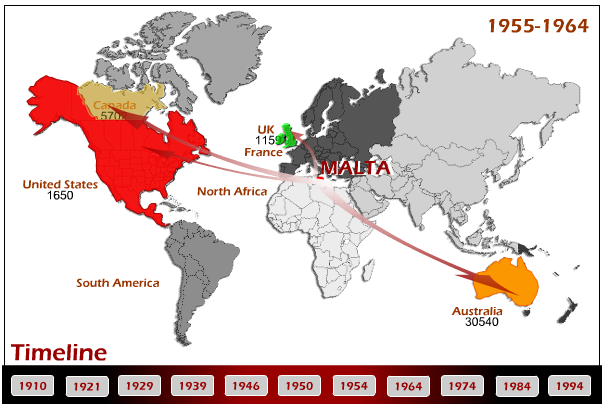
Malta to Australia: Despite decades of issues with emigration to Australia including public sentiment toward lower cost foreign workers, the Maltese and other Southern Europeans being classified as ‘non-white’, language, literacy and a lack of financial incentives for travel, Australia finally became the overwhelming destination of choice for Maltese emigrants in the 1950s and 1960s. The Australian government started offering assisted passage to Maltese emigrants in response to the employment crisis following World War II. Hundreds of passenger lists and Australian death records to present day attest to the substantial number of Baldacchinos who settled in the country, amongst the 349 Maltese surnames found by M Caruana in Australia’s year 2000 phone directories. The dominance of Australian migration in the second half of the 20th century is highlighted by the summaries below.