In the Beginning
With the departure of the Knights of St John from Malta at the end of the 18th century, Tunisia made the enslavement of Christians illegal in 1818, opening the door to European immigration. Until the 1870s when Italians took precedence, the Maltese had comprised the majority of the European presence in Tunisia. The fluctuating economic conditions at home, low cost of reaching Tunisia on local fishing boats, common climatic and maritime environments and the closely related languages of Maltese Malti and Tunisian Arabic drew substantial numbers of migrants to North Africa. The first Baldacchino baptism found to date was in 1826 and the early Baldacchinos mostly remained in Tunis, working as drivers, shopkeepers, traders and craftsmen, summarised by A Smith as ‘the Maltese were a largely working population involved in a wide variety of enterprises’ (Andrea L Smith, ‘The Maltese in Tunisia before the Protectorate: 1850s-1870s: Towards a Revised Image’, Journal of Mediterranean Studies, Vol 10, No 1 & 2 (2000), p 191)). The surname is mainly spelled Baldacchino, occasionally Baldachino.

Migration
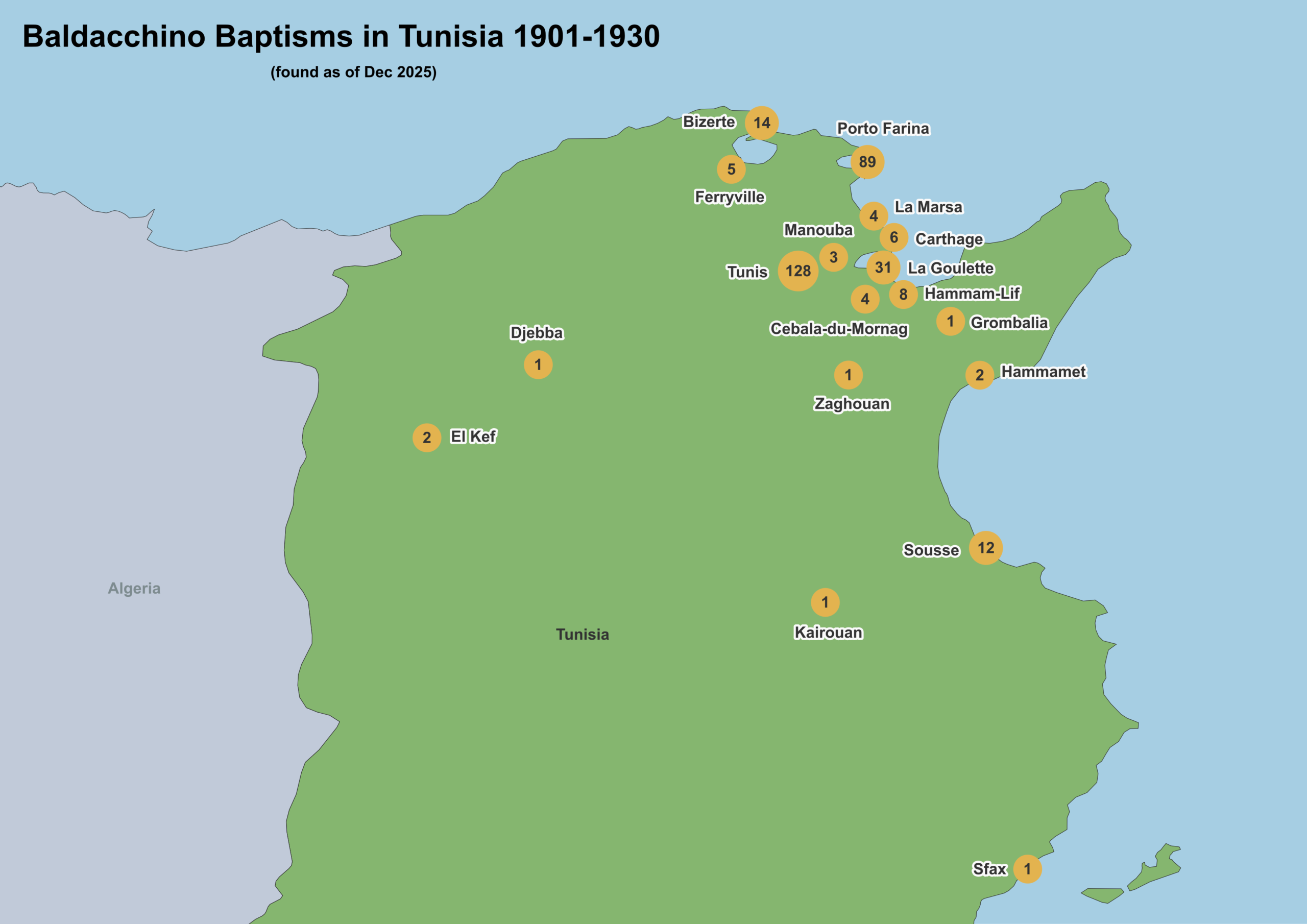
While most Maltese are thought to have returned to Malta, a significant number settled into permanent presence in Tunisia. They were still mainly located in Tunis with the Catholic church registers of Tunis containing many Baldacchino birth, marriage and burial records. However, there was also a significant spread to coastal areas as numbers increased, mostly still in the vicinity of Tunis but some to points further south. Maltese worked in these communities as fishermen, shepherds and agriculturalists such as olive tree growers. A Smith contends that much of the maritime work was of contraband exchange between Europe and Tunisia where export taxes and prohibitions could be high and that the Maltese were a well-placed ‘liminal’ community bridging both cultures. Some Baldacchino burials have even been found over 500 km south of Tunis on Djerba, a large Tunisian island not far from the Libyan border. They worshipped at St Joseph’s, described in the 1890s as:
‘The White Fathers replaced the Capuchin friars; subsequently, priests from various congregations took over. The Christian population was predominantly made up of Maltese fishermen, even during the French protectorate, to the point that catechism and homilies were in Tunisian Arabic, closely related to Maltese. Cardinal Lavigerie warned the priests he appointed to this parish: “Djerba is three or four hundred Christians lost among some thirty thousand Muslims.”‘ (https://www.eglisecatholiquetunisie.com/les-paroisses/djerba-saint-joseph/, Google translation).
St Joseph’s was ceded to the Tunisian government in 1964 but re-opened in 2005 by Presidential decree. It continues to hold masses for European residents and tourists on the island today.

The Surname Today
Forebears.io does not identify anyone living in Tunisia today with the Baldacchino or variant surname. Some Baldacchinos remained in Tunisia after its independence in 1956, with 50 burials found to date between 1951 and 1996. About half of these people were buried in Tunis and the remainder were mainly in Porto Farina. However, along with other Europeans, most of the Maltese departed. Malta’s doors were generally closed to those returning, however their French citizenship entitled them to resettle in France where there remains a large Maltese population today. French death records identify that most Baldacchinos and Baldachinos in France had immigrated from Tunisia.