In the Beginning
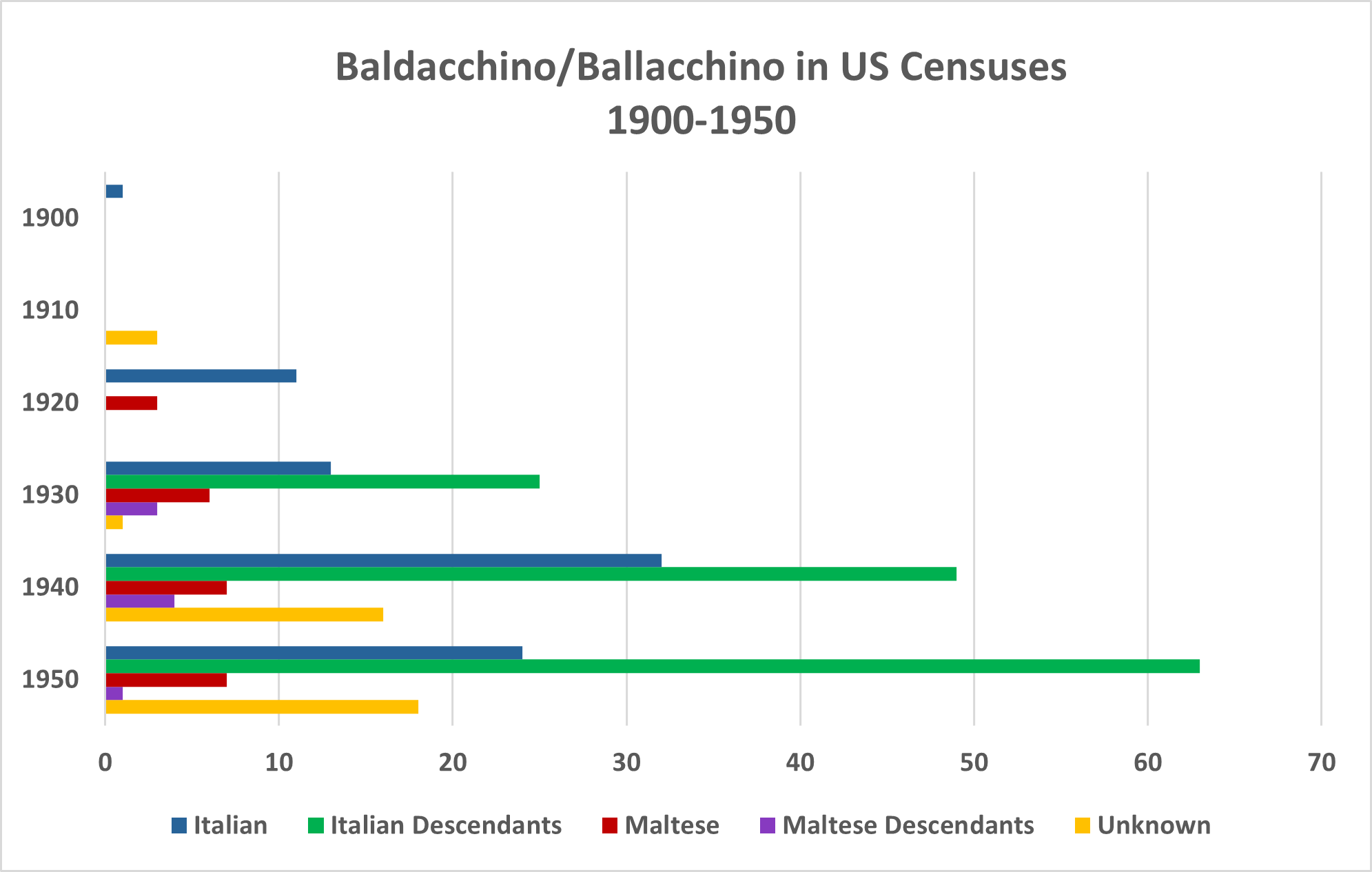
The re-unification of Italy in 1861, termed Risorgimento, resulted in an economic downturn in southern Italy and especially Sicily along with heavy impacts due to a new requirement of seven years of military service. Between 1900 and 1915, over a million Sicilians or almost a quarter of the island’s population, emigrated with about 90% choosing the United States. The earliest records found to date for Baldacchino and Ballacchino migrants begin with the arrival of Angelo Ballacchino at Ellis Island, New York in 1892, signalling the beginning of the first wave of migration of Baldacchino and related surnames to the USA. Italian migration dropped sharply with the introduction of the Johnson-Reed Agreement in effect from 1924 to World War II, an agreement that severely curtailed the number of Italians and other Southern Europeans allowed to enter the United States. However, the presence of these surnames was already well-established with the overwhelming majority arriving from Sicily. For the Ballacchino surname, most were still from the town of Licata, Agrigento, Sicily where this variant surname originated. Census records, available to 1950, identify the impact of this initial wave of migration, with most Baldacchinos and Ballacchinos having become the children and grandchildren of native Italians by the time of the 1950 census. In 1950, these emigrants and their descendants were residing primarily in New York (40%) and Ohio (about 30%). The large group in Ohio were almost all Ballachinos, using a single ‘c’ rather than the double ‘c’ used in Italy.
Migration
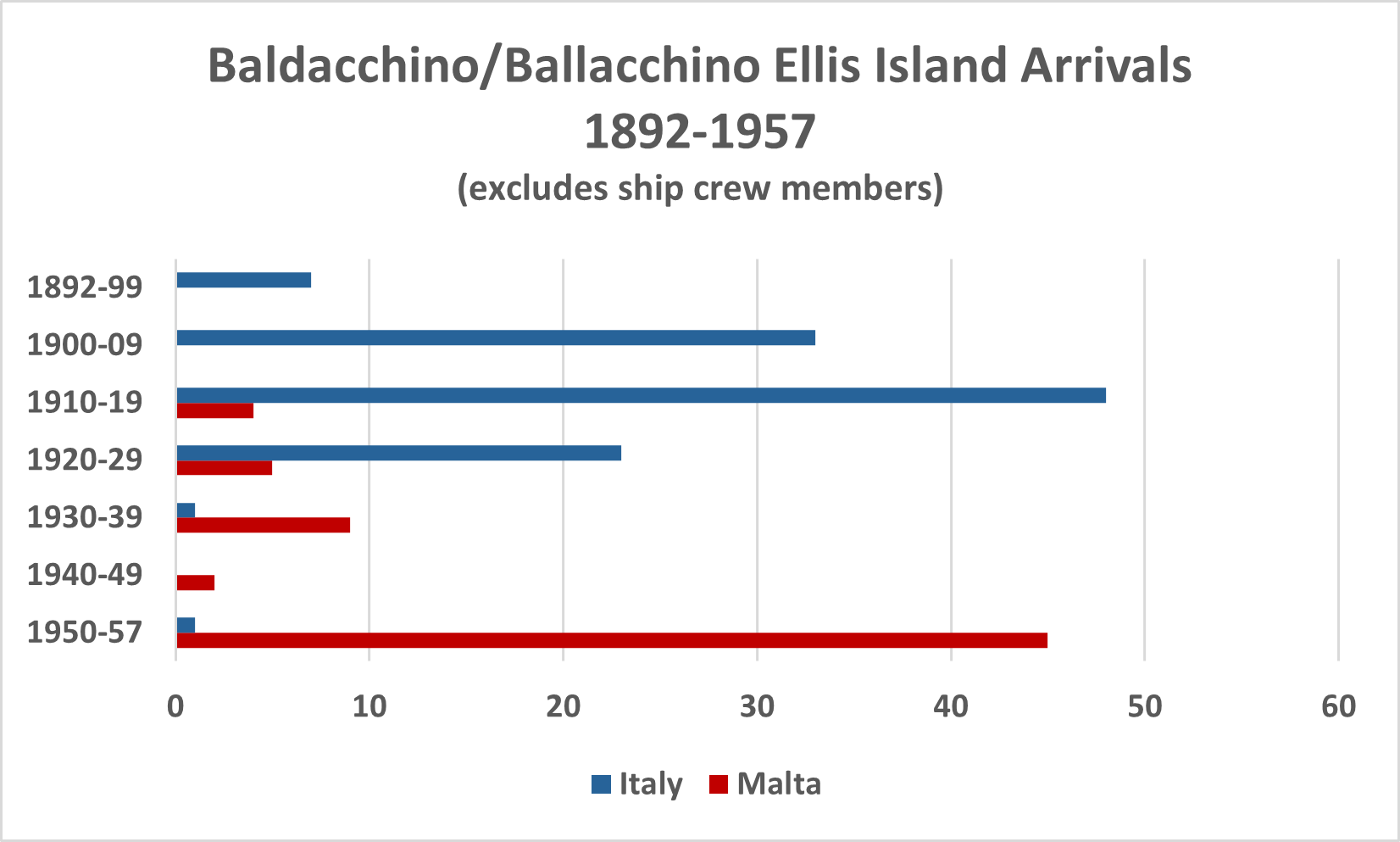
The second wave of migration of Baldacchinos to the USA began slowly just before World War I with the arrival of the earliest migrants from Malta. After World War II, Malta faced an unemployment crisis and began providing financial assistance to those who wished to emigrate. Although Australia was the most popular destination, many also chose the United States. Arrivals of Baldacchinos at Ellis Island, with records available to 1957, show the dramatic shift from Italian arrivals in the early decades of the century to (British) Maltese arrivals in subsequent years. Although arrival records are only sparsely available after 1957, Maltese migration is known to have continued into the 1960s.
Records for the latter decades of the 20th century are mostly unavailable due to privacy requirements but a third wave of migration, this time for the variant surname Baldoquin, would take place following the Cuban Revolution of 1959. 14 naturalization records have been found so far, with arrivals of Baldoquins from Cuba starting in the early 1960s and naturalizations found to date mostly in the 1970s and 1980s. These naturalizations took place in Miami, Florida and Los Angeles, California. 20 marriage records have also been found between 1967 and 2021, mostly in Florida but also California and a few other states, along with 15 death records in the same timeframe. The Cuban Baldoquin migrants were of Maltese descent as explained on the Cuba page.
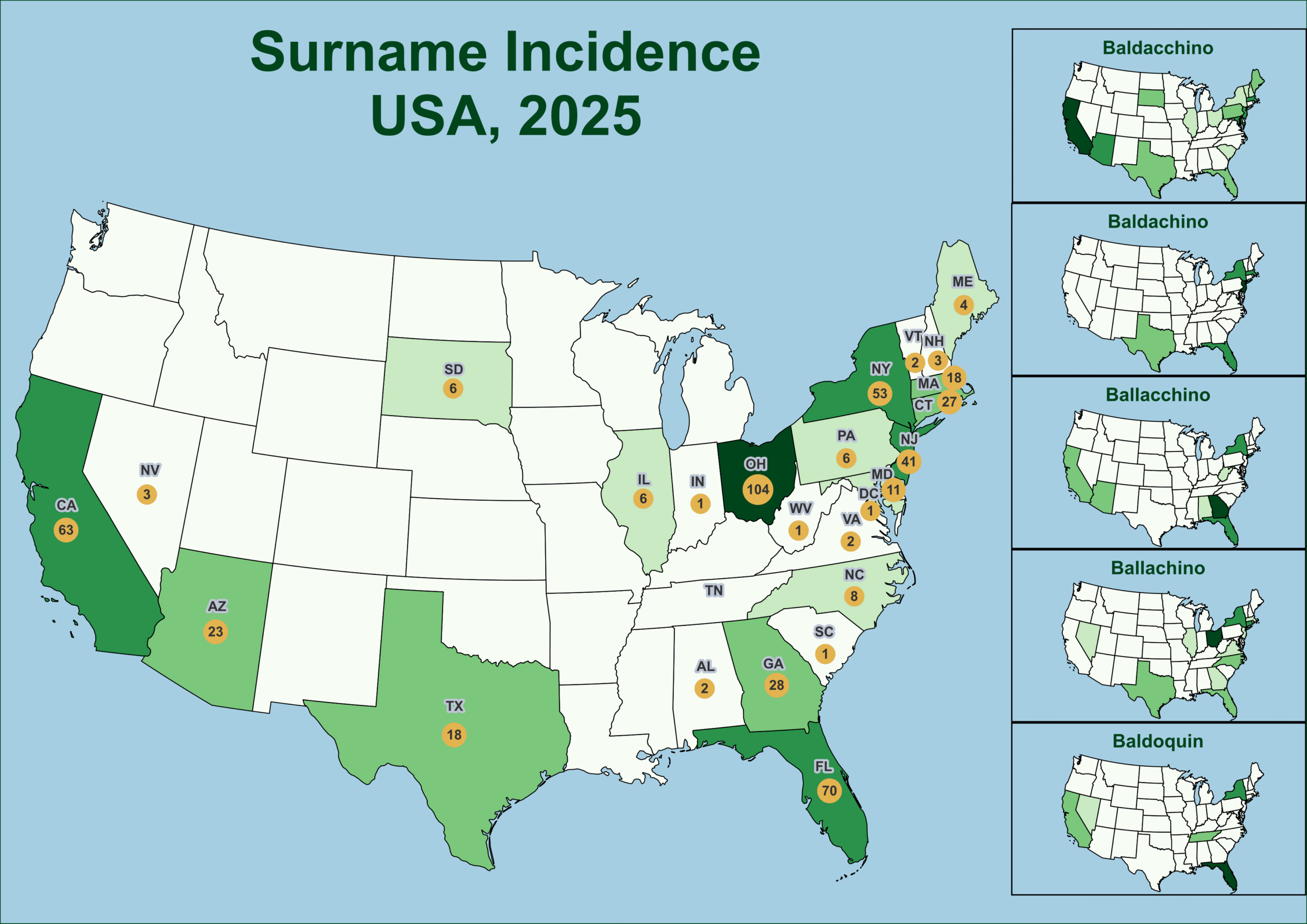
The Surname Today
forebears.io estimates that, in 2025, the United States was home to 158 Baldacchinos, 34 Baldachinos, 2 Baldaccinos, 67 Ballacchinos, 205 Ballachinos and 52 Baldoquins. True to form, the United States reflects a mixing pot of names from both Sicilian and Maltese descent. The Ballachino variant form is most prevalent, the single ‘c’ being a variation that is rarely found elsewhere in the world. Considering all of the forms of the surname, Ohio is most popular with over 100 Ballachinos. California features strongly especially for Baldacchinos, Florida for Baldoquins, Georgia for Ballacchinos, New York for Ballacchinos and Ballachinos, and New Jersey for Baldachinos.